Demographic change and intense competition for talent are creating new challenges for Germany’s laboratories. If you not only want to maintain your laboratory operations under these changing conditions, but also secure your competitiveness in the long term, you need an effective strategy. In this article, you will find out which strategies you can use to overcome the skills shortage and how lean management can help you.
The shortage of skilled workers is an enormous challenge for many companies. Many laboratories are already suffering from Germany’s demographic problems. The population and the number of people entering the workforce will decrease in the coming years, in some cases significantly. Forecasts suggest a decline of around half a million inhabitants as early as 2030. A drop that cannot be compensated for by immigration from abroad. Even a possible stuttering of the economic engine will not eliminate the shortage of skilled workers.
The situation is becoming particularly tight in the technical and scientific fields. There are already shortages in 16 out of 35 professions, according to a study commissioned by the Federal Association of Chemical Employers (BAVC). The “war of talents”, the competition for the best workers, has been a reality for years. This particularly affects the laboratories of small and medium-sized companies. They often lack the financial resources and also the name recognition of larger companies to convince potential candidates when looking for personnel. The shortage of skilled workers is therefore not only a very important challenge for many companies in this sector today, but also a real danger. After all, those who lose out in the long term must inevitably expect negative consequences for business development.
For laboratories, this means in the worst case scenario: cost increases in recruiting staff and missed opportunities for growth. Sometimes it even means that investment projects are postponed or plans to build a new laboratory are put on hold. Added to this are the stressful consequences in everyday working life: the laboratory team has to cope with more and more work, more and more samples and ever greater demands without the help of new colleagues.
Strategies against the shortage of skilled workers
So much for the bad news, but there is also good news: those who pursue a suitable strategy need not worry so much about the skills shortage. But not all possible strategies promise the same contribution to countering the skills shortage.
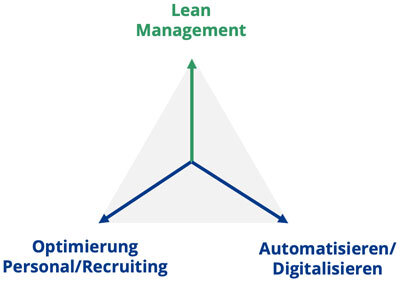
Possible strategy no. 1: Improve HR work
Skillful employer branding and increased recruiting are an important first step. Improving the attractiveness of the workplace and the environment is just as important. Intelligent measures, which don’t have to cost that much, often make a huge difference here. Laboratories in rural areas in particular benefit from this. But even in highly competitive urban areas, the corporate culture and thus the attractiveness of the perception by applicants can be increased. However, it is difficult to estimate how much effort is required to make a significant leap in attractiveness, as the competition never sleeps.
Possible strategy no. 2: Automation and digitalization
Ways out of the shortage of skilled workers result from the megatrend of digitalization and automation. This allows productivity and output to be increased without additional employees. This important strategy helps in the medium and long term, but is often not effective in acute staffing problems. After all, if you want to go down this path, you need technically qualified employees to select and successfully introduce new digital solutions and automation. Such employees are often even harder to find on the labor market than employees for the laboratory. In addition, technically qualified employees alone are usually not enough to successfully automate a laboratory.
Possible strategy no. 3: Lean management
Lean management is the third and often most effective strategy for dealing with a lack of specialist staff. It not only helps industrial companies, health insurance companies and banks. Laboratories often do not necessarily need more specialists, but a sustainable introduction of lean in the laboratory.
It is easy to explain why this is the case: Handling inefficient processes with more and more skilled workers is not a solution, but a waste of valuable employee resources. If you work more productively with your existing workforce, you can save yourself the tedious and costly search for additional specialists. More efficient processes and workflows in the so-called “lean lab” therefore replace the headhunter.
The positive effects of lean management are scientifically well documented:
Lean management has a positive effect on productivity, quality and the speed of work processes – as numerous studies have shown. In hospital emergency rooms, for example: Here, lean not only improved the quality of treatment as measured by key performance indicators. Lean laboratory optimization also brought about positive and sustainable changes in employee behaviour.
In addition, Lean is easy to learn, even for laboratory technicians without a business background, and in a relatively short time. Remarkable effects can be seen within a year of introducing lean. This makes lean techniques a lifeline for laboratories suffering from a shortage of skilled staff!
What lean does in the lab
The untapped potential of lean in the laboratory is huge. Studies show that “Lean Lab” is an issue in 90 percent of companies. However, many laboratories are not even close to exploiting the considerable potential of these techniques. Only a fraction of them realize all the benefits associated with it.
Because the 5S methodology for the efficient and ergonomic organization of workplaces is by no means the end of the story when it comes to lean in the laboratory. There are also 50 other techniques for making laboratory processes more productive, more reliable and faster. Lean is not only the method of choice when it comes to testing procedures in the laboratory, but also for supporting activities and when remodeling or building a new laboratory(lean lab design). The positive effects can also be seen in management behavior through greater effectiveness and efficiency of laboratory managers(lean leadership). Lean leaders waste less time on non-essential meetings, emails and other work that does not directly add value. This demonstrably leaves more time for activities that directly increase value creation.
This effect can also be seen in laboratory technicians who mainly perform operational work. For them, the proportion of value-adding activities is also often low. During tests, for example, a lot of time is lost walking to procure materials. Complex processes that do not have a positive effect on the quality of work also often have a negative impact. Lean management techniques effectively combat this waste. With their help, improvement opportunities can be identified and solutions for less waste can be developed.
The result: the entire team in a lean lab works more efficiently without extra work or running faster. The work is also often perceived as less stressful, as processes are better structured. This means that a large part of the increasing volume of work and samples can be absorbed – with the existing team and without additional staff.
Sources:
- Federal Association of Chemical Employers (BVAC) (2018): Skilled labor check – The shortage is becoming tangible
- Deloitte (2018): CFO Survey Fall 2018: CFOs under pressure – skills shortage and indirect costs
- Dickson/ Anguelov/ Vetterick/ Elller / Singh (2009): Use of Lean in the Emergency Department: A Case Series of 4 Hospitals
- Press portal for the study “25 years of lean management” from 14.04.2016
Event: Lean management in the laboratory
If you would like to find out more about how you can optimize your laboratory processes by using lean techniques, for example, take a look at our “Lean management in the laboratory” event.