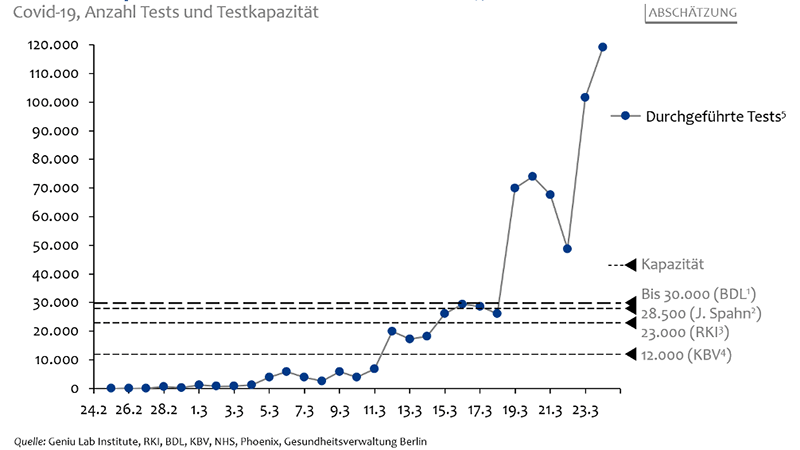
Testing and separating people infected with coronavirus is an essential part of the containment strategy. Testing capacity is therefore of crucial importance. Various estimates of testing capacity are circulating in the media. None of them seem to be anywhere near correct – because no one can really know the capacity at the moment. However, a calculation by Geniu Lab Institute shows that the actual test output is already above the estimated values – i.e. already “over the limit”.
Covid-19 is spreading rapidly around the world. In Germany, too, growth is over 20%. An essential part of the containment strategy is the testing and separation of people infected with coronavirus. Testing capacity is therefore of crucial importance. WHO Director-General Dr. Ghebreyesus describes the challenge as follows: “We cannot stop the pandemic if we do not know who is infected. So the simple request to everyone: test, test, test!”6 Germany is reported to be testing at an above-average rate. But how long can the number of people being tested continue to rise before the limit is reached?
No one knows the actual capacity
The Society for Virology lists 54 organizations7 on its website, i.e. university hospitals, non-university institutions from the public health service and some private laboratories that offer SARS-CoV-S PCR tests. In total, it is assumed that there are around 200 to 300 laboratories8. So far, however, there is no system that centrally records testing capacities.
Nevertheless, various media outlets are quoting or reporting live on statements made by people about testing capacity. These include the Federal Minister of Health, Mr. Spahn, the head of the Robert Koch Institute (RKI), Lothar Wieler, and the spokesperson for the Federal Association of German Laboratory Doctors (BDL). According to these figures, the test capacity is between 12,000 and 30,000 per day or 84,000 and 200,000 per week. But can this really be true?
Number of tests performed as an indicator of capacity
It is possible to consider the number of tests carried out as an indicator of capacity. This can be calculated from the number of infected persons confirmed by laboratory tests per day and the proportion of those testing positive. The number of infected persons is determined daily by the RKI. Values are available for the proportion of those testing positive, both from Germany and for verification from other countries. According to the Berlin Health Administration, for example, the proportion in week 11 was 4.3%.9 A similar figure of 4.9% was reported by the British health authority NHS as of March 18.10 A lower figure of 2.7% is reported by the South Korean KCDC.10 This is probably due to the fact that testing in South Korea is even more extensive than in Germany.
Already at the limit
If we assume a value of 4% for the number of positive tests, then the number of tests carried out is already over 100,000 per day and therefore already well above the highest “capacity value” of 30,000 per day – i.e. well “over the limit”! It is therefore not surprising that many laboratories are complaining of massive overload. If the pandemic continues to spread at a rate of 20% per day, it will be an extreme challenge for laboratories. Therefore, it is not just politics that is needed, but coordinated action to ensure the availability of equipment and materials and to make the best possible use of capacities by optimizing processes, e.g. with the help of lean management techniques.
Sources:
- 1 Federal Association of German Laboratory Doctors [BDL] (reported on Bayerischer Rundfunk on 18.03.2020)
- 2 Statement by Federal Minister of Health Jens Spahn on “Phoenix vor Ort” (live) at 2 p.m. on 23.03.2020: 200,000 per week, i.e. approx. 28,500 per day
- 3 Robert Koch Institute [RKI] (reported in RBB on 18.03.2020 of capacity of 160,000 per week, i.e. approx. 23,000 per week)
- 4 National Association of Statutory Health Insurance Physicians [KBV] (reported in the FAZ on 14.03.2020)
- 5 Number of tests carried out calculated with the number of positive tests of approx. 4% (based on current values from NHS, KBV, Berlin health administration), confirmed for CW 10 and 11 by KBV case numbers
- 6 Report from ARD Extra on 19.03.2020
- 7 Link accessed on 24.03.2020 at www.g-f-v.org/node/1233
- 8 Federal Association of German Laboratory Doctors (BDL), reported on 18.03.2020 on the website of Best regards (“Corona tests: Laboratories at the limit”)
- 9 The RBB reported on this on March 18, 2020 in the article “Less than five percent of tests in Berlin laboratories positive”.
- 10 Der Spiegel reported on this in the article “Why is the death rate lower in Germany?” on March 19, 2020.