Lean Lab: A journey through the application of lean in the laboratory

Bildbeschreibung hinzufügen

The term lean was coined by an MIT study in 1991. In 2001, the first lean project in the USA was publicly reported. In literature, “Lean Lab” was first mentioned in 2005: at that time with the subtitle “A new way of thinking”. Since then, lean techniques have spread around the world and proven themselves in thousands of projects in laboratories. In addition, a large proportion of the literature published in scientific journals in particular no longer originates from the USA.

The origin of Lean Lab

At the turn of the millennium, the first Lean Lab projects were launched in US hospital laboratories

The term “lean” was coined by the MIT study in 1991. It took almost ten years for lean to be put into practice in the laboratory. At the end of the 20th century, Johnson & Johnson & Co. introduced another service for its hospital customers through its subsidiary Ortho Clinical Diagnostics (OCD): Laboratory Optimization with Lean Management and SixSigma techniques.

OCD’s first “beta project” took place in 2001 in the laboratories of the BayCare Health System hospital in Clearwater, Florida, USA. With great success: Throughput times were not only reduced but also adhered to by over 95%. In addition, the first project saved more than USD 300,000. It also helped to alleviate the shortage of skilled workers.

This and other LeanLab projects and their sometimes dramatic improvements in a short space of time were reported on in detail in the following years. For example, field reports from projects in 2002/2003 were presented at the annual conference of pathology laboratories in 2003. Lean Lab was described here as a “revolution” for the “management of laboratories”.

Laboratory segments with initial application projects

Reasons for early application in hospital laboratories

Is it a coincidence that Lean was first introduced in hospital laboratories? Why was Lean not first applied in pharmaceutical industry laboratories? This may indeed be a coincidence. But there are also several reasons why this sector is predestined for the application of Lean.

The pharmaceutical industry, for example, was the most profitable industry in the world for two decades until 2000 (see Garnier, 2008). Accordingly, there was less pressure to further increase profitability through optimization. In addition, many managers originally believed that the introduction of lean was not possible due to the high compliance requirements of the pharmaceutical industry. This view is now considered outdated. Over the last few decades, it has been shown that the application of lean techniques in particular contributes to improving the reliability of processes.

For pathology and histology laboratories in hospitals, on the other hand, the need for optimization was greater: for example, because hospitals were under considerable cost pressure and at the same time laboratory results had to be available in the shortest possible time in order to be able to treat patients quickly. In addition, the volume of samples is quite high and the variety of analysis methods tends to be low in many laboratories, so that optimizations have a very rapid impact. It is therefore not surprising that lean was first applied in hospital laboratories. This is also reflected in the publications: In the first 5 years, ~75% of articles were published on hospital laboratories. Today, lean is used in all types of laboratories.

Pioneers of Lean Lab

Mark Jamrog, born in 1954, grew up near Detroit (USA) and was one of the first to learn about lean techniques on site in Japan in the 1980s, applying them as a plant manager in the automotive industry, among other things. At the end of the 1990s, he worked as an independent consultant for Ortho Clinical Diagnostics (OCD) and was one of the first to bring lean into laboratories.

First research work on Lean Lab

The origin of “lean in the lab” in the literature

It took a few more years before the topic of lean arrived in the laboratory literature. For example, none of the books on laboratory management published around the turn of the millennium included the topic of lean, nor was the topic mentioned. According to our research, the term was first addressed more comprehensively in the literature in the scientific work “The Lean Laboratory” by Thomas C. Trible from 2005. There, lean in the laboratory was still “A new way of thinking”.

As a result, Trible describes the topic of lean as “generally unknown to the laboratory industry” in 2005 and the central question was still: “Can lean thinking be applied to the laboratory industry? A question that hardly anyone is still asking a good fifteen years after his work.

Development of publication activity

Publications on Lean Lab: Originally influenced by the US – now worldwide

In the years that followed, the topic of lean management in the laboratory was dealt with more intensively in the literature. It is not surprising that the majority (around 80%) of all literature published in the last twenty years comes from the USA – the country in which the MIT study was conducted. Until 2009, only two articles did not come from the USA. However, in the years since 2010, the proportion of literature from outside the USA has increased significantly. In the last five years, the proportion outside the USA was almost half. Articles on the topic of lean labs have even been published in Namibia, Malaysia and Saudi Arabia.
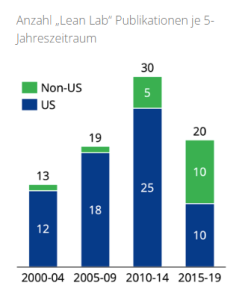
It is also interesting to note that around 75% of the articles were published in scientific journals, but only to a lesser extent in business-oriented publications. In addition, around two thirds of the articles appeared in “practitioner journals” (e.g. Medical Laboratory Observer, MLO) and one third in journals with a scientific focus (e.g. Journal of Clinical Laboratory Analysis). Some of the articles were even published in prestigious journals such as “The Journal of Molecular Diagnostics” or the “Journal of Clinical Pathology”

(Journal Impact Factor: 3.35 and 1.3, source: Research Gate, 2018 and 85 and 116 according to Scimago Journal Rank) and have, for example, systematically investigated the benefits of introducing lean in laboratories.

Lean Lab

Short form “Lean Lab” has become established over the last 10 years

Lean Management + Laboratory= Lean Lab

Lean management in the laboratory: this is the “official” term, which was still widely used both at the beginning and today. However, the abbreviation “Lean Lab” has been used more and more since 2005 (sometimes also as a combined term “LeanLab”). Initially, especially in the term “Lean Lab Design“. Our research shows that the compact term “Lean Lab” became increasingly established from 2010 onwards. Today, the term is used for laboratory optimizations of various kinds.

MAIN TOPICS

Lean for laboratory processes, Lean Lab Design and Lab 4.0

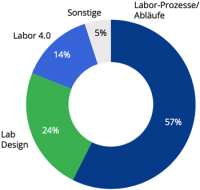
Share of all "Lean Lab" publications by topic

The central themes of the publications on the subject of lean labs revolve around three topics: Firstly, the design of a lab layout according to lean principles (also called “lean lab design“) with 21% and secondly, the application of lean to the workflows and processes in the lab (76%). In the last 3 years, the topic of the lean lab has also emerged in connection with digitalization or “Industry 4.0” – also known as “Lab 4.0” or “Smart Lab”.

The first topic, “Lean Lab Design”, sometimes also called Lean Lab Layout, deals with the planning of a laboratory for a conversion or new building. In the latter area, which deals with the optimization of laboratory processes, there are three different focal points: (1) increasing efficiency by reducing waste, (2) reducing throughput times from sampling to the finished test result and (3) improving the reliability or quality of processes.

Lean lab and lab types

Focus on routine laboratories - increased use in R&D laboratories in recent years

Since 2001, both the practical application and the literature have primarily dealt with routine laboratories, i.e. quality control laboratories (so-called “QC laboratories” or “in-house laboratories”) from manufacturing companies or contract laboratories (the proportion of literature is 99%). This is not surprising, as lean management techniques were invented and primarily applied for many years in manufacturing companies with repetitive activities.

Even today, there is still often the view that lean is only applicable there. However, this is not the case. This is confirmed not only by publications on lean in research and development projects, but also by successful projects. However, if you then bear in mind that the proportion of waste (in the sense of the 7 types of Lean waste) is significantly higher in development activities than in routine activities and that many Lean principles and techniques are also valid in essence, it becomes clear why more and more R&D laboratories have been applying Lean in recent years.

Geniu and Lean Lab

Geniu consultant among the first to apply Lean in the laboratory in Europe

The laboratory in Ireland had around 35 employees and the project in the laboratory took place as part of a lean transformation of the entire production site. The results were convincing: more than 50% optimization potential (in terms of the seven types of waste) and extensive opportunities to reduce throughput times were identified.

Pharmaceutical companies in Ireland in 2008

Even before lean management was increasingly used in laboratories in Europe from 2010, Geniu consultants were already applying lean in the laboratory. For example, in 2008, Geniu founder Dr. Wolf-Christian Gerstner, together with a former Toyota employee and lean expert, introduced lean in a quality control laboratory at a pharmaceutical company plant near Dublin (Ireland). In the following years, projects followed in other countries such as Poland, China, Germany, Switzerland and Israel.

"Only those who know the past can understand the present and shape the future."

- August Bebel -

Sources:

  • Ganier, J.-P., Re-building the R&D engine in Big Pharma, Harvard business review, May 2008, Vol. 86, Issue 5, pp. 68-76
  • Trible, T. C. , The lean laboratory: A new way of thinking, UMI/ProQuest, 2005
  • Michel, R., Lean Management helps Bay Care’s Lab boost Quality, The Dark Report, Vol. VIII, No. 14, Oct. 15. 2001

Become a consultant

    Data protection notice

    Your request will be sent encrypted via our server. We will only use your details to process your request. Further information and revocation notices can be found in our privacy policy.

    [wpmlcf7-5-honeypot first-name]
    Submit
    [/wpmlcf7-5-honeypot]

    Registration

    Your registration for the event
    The origin of lean in the laboratory

    Request a quote

    Please send me a non-binding offer on this topic.

      Data protection notice

      Your request will be sent encrypted via our server. We will only use your details to process your request. Further information and revocation notices can be found in our privacy policy.

      [wpmlcf7-6-honeypot first-name]
      Submit
      [/wpmlcf7-6-honeypot]

      Arrange a meeting

      Please contact me for further information on this topic.

        Data protection notice

        Your request will be sent encrypted via our server. We will only use your details to process your request. Further information and revocation notices can be found in our privacy policy.

        [wpmlcf7-5-honeypot first-name]
        Submit
        [/wpmlcf7-5-honeypot]

        Callback service

          Data protection notice

          Your request will be sent encrypted via our server. We will only use your details to process your request. Further information and revocation notices can be found in our privacy policy.

          [wpmlcf7-7-honeypot first-name]
          Submit
          [/wpmlcf7-7-honeypot]

          Newsletter


            Subscribe to our newsletter now. You will receive the latest news on current laboratory trends and regulatory changes as well as suggestions for laboratory optimization.

            Data protection notice

            Your request will be sent encrypted via our server. We will only use your details to process your request. You can cancel your registration at any time. We will never pass on your contact details. Further information and revocation instructions can be found in our privacy policy.

            [wpmlcf7-4-honeypot first-name]
            Log in
            [/wpmlcf7-4-honeypot]