Our topics
Our laboratory expertise covers the entire spectrum of laboratory management challenges. From day-to-day operations to organizational and strategic issues.
We offer both consulting and training on all the topics presented. We have also developed laboratory-specific online courses for many of the topics.
Lean in the lab
Lean management refers to a series of methods, procedures and principles for the efficient organization of the entire value chain. Many laboratories have applied lean over the last two decades and have increased their productivity, reduced throughput times and increased the reliability of processes. Lean has thus become a proven and indispensable component of successful laboratory management.

Lean laboratory processes
The execution of tests can be fundamentally optimized using lean techniques. This can improve employee productivity by up to 50% and reduce errors.
Lean Lab Design
With a suitable approach to the design of the laboratory, efficiency gains can be realized that can usually no longer be addressed cost-effectively after completion.

Lean device layout

Lean documentation
Lean Lab Supply
Lean Leadership
The organization of management tasks in the sense of “lean leadership” helps to achieve the goals set better and more easily and to reduce stress in everyday laboratory work.


Waste analysis
The waste analysis makes it possible to identify and quantify optimization opportunities in laboratory procedures and processes of various kinds (“7 types of waste”).
Route analysis
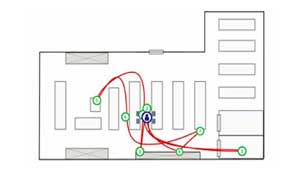
With the help of the running route or “spaghetti analysis”, you can identify the causes of running in the lab and learn where you can start to optimize.
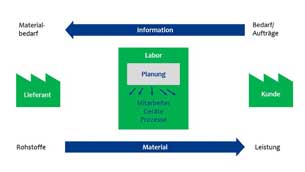
Value stream mapping
A value stream analysis visualizes the material and information flows of a laboratory and reveals approaches for holistic optimization.
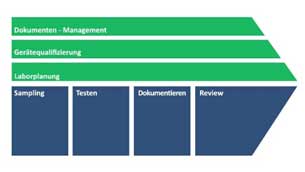
Process mapping
Processes can be systematically analyzed with the help of process mapping. Best practices are also defined and made available to all employees.
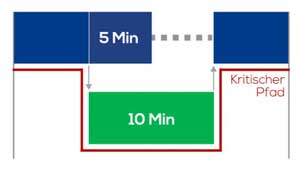
Critical path analysis
By analyzing the critical path of activities or checks running in parallel, small and medium waiting times can be reduced and capacities optimally utilized.
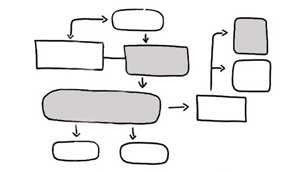
Swimlane diagram
The so-called “swimlane diagram” is an effective technique for analyzing and optimizing multi-stage processes with several participants.
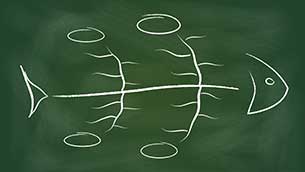
Ishikawa diagram and 5 Why method
With the help of the so-called Ishikawa and 5 Why techniques, the causes of errors in the laboratory can be effectively determined and subsequently eliminated.

Root cause analysis
In order to reduce errors – especially recurring errors – a systematic analysis of the errors and their causes is necessary.
Overall Equipment Efficiency (OEE)
In order to achieve a higher throughput of laboratory equipment, losses in equipment availability must be determined. The OOE analysis also identifies starting points for optimization.
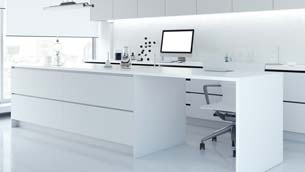
5S in the lab
5S is an established technique for designing workplaces safely, ergonomically and efficiently in five steps. In the module, the basics of the 5 steps are taught and applied in an exercise.
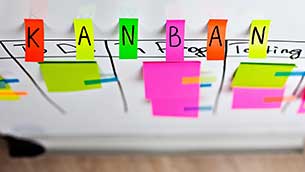
Kanban, pull and milk run
Efficient replenishment of materials not only pleases laboratory staff but also contributes to productivity. Principles such as Kanban, pull and milk run are important for this.

Poka Yoke
With the help of Poka Yoke, so-called “unintentional” errors can be avoided very effectively through simple, technical precautions or systems.
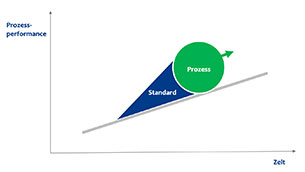
Standard processes
Standard processes (also known as “best practice processes”) are an important basis for sustainable and continuous improvements in the laboratory.

Selection of optimal storage locations
Optimal storage locations for materials and utensils at the workstation and in (temporary) warehouses enable efficient and fluid processes and contribute significantly to productivity in the laboratory.

Determine optimum device layout
An optimal arrangement of the devices, which takes into account the various dependencies between devices, forms the basis for efficient processes with short walking distances.
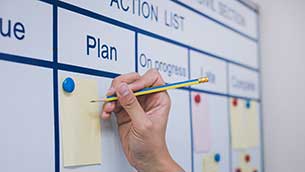
Visual Management
With the help of “Visual Management”, the current situation of a laboratory can be displayed transparently (e.g. on a board). It enables performance to be discussed effectively.

Gemba
Gemba Walks” involve managers being on site in the laboratory and developing optimization options immediately when problems arise.
Laboratory new construction and conversion
Planning the renovation, conversion or new construction of a laboratory is a complex and exciting task. For many managers, it represents a unique challenge in their professional lives. In addition, the design of a laboratory layout requires the involvement of laboratory technicians and intensive coordination with many partners: architects, laboratory planners, structural engineers and laboratory furniture and equipment manufacturers. With the right approach, the planning effort can be reduced and the efficiency of processes and employee satisfaction increased.

Lean Lab Construction
The execution of tests can be fundamentally optimized using lean techniques. This can improve employee productivity by up to 50% and reduce errors.
Lean Lab Design

Optimize land use

Lean Lab Supply
Laboratory management
The demands placed on laboratory managers have increased in recent years. In addition, the range of tasks has become more diverse: a constantly changing regulatory environment, increased expectations of “good management” of employees, effective control through the use of key figures and, last but not least, the need to increase quality, costs and time through lean management techniques. In order to meet these expectations, it is more important than ever for managers to continuously expand their knowledge and apply it in everyday laboratory work.

Profitability analysis
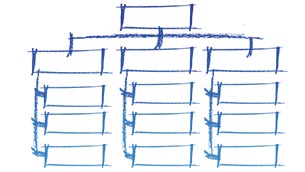
Laboratory organization

Laboratory strategy

Laboratory outsourcing
Lead time & agility
In a world of ever shorter response times and regular changes, it is important to react quickly and adequately to changes. But regardless of this, it is also important for laboratories to continuously reduce the throughput time of tests and projects.
Optimization of throughput time
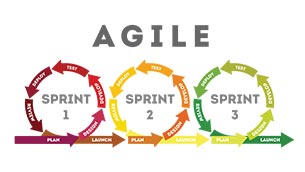
Agile Labs

Planning for efficiency & speed